Jumbo Frames
The WANBOX VLL technology uses Jumbo frames to achieve higher protocol efficiency.
With a larger frame size and thus a larger payload size, the WANBOX VLL technology achieves less protocol overhead, and the bandwidth saved is available for the packets’ payload. This feature also helps in the real-time compression mechanism, as it enables a greater degree of data compression, saving even more bandwidth from the available WAN connections.
Forward Error Correction
Real-time application traffic can be duplicated to guarantee no loss and optimal performance.
This feature normalizes the performance of real-time applications by transmitting data in redundant mode via multiple WAN paths.
The system selects the best two WAN connections in order to transmit two identical copies of the real-time data packets at the same time. Whichever packet gets through first, is the one to be delivered. This feature guarantees the smooth operation of real-time protocols even when the available individual WAN connections face high packet loss and jitter.
Special Purpose Connection Legs
This technology feature allows specific WAN connections to be used by the bandwidth aggregation algorithm for specific types of traffic. As a result, the corporate network can take advantage of WAN connections with traffic caps for business critical applications.
This feature allows the configuration of sophisticated policies regarding the utilization of the available WAN connections. In fact, it allows each connection to be used by the bandwidth aggregation algorithm for specific QoS classes. This results in further increasing the available bandwidth or enabling additional WAN paths for redundancy.
Policy Based Routing
It allows the definition of rules in order to route specific types of traffic directly via specific WAN connections
The Policy Based Routing functionality provides an extremely powerful, simple, and flexible tool to implement advanced routing policies. In cases of legal or political constraints, the system can be configured to route specific traffic through local ISP connections.
Legacy session Load Balancing
The legacy session load balancing functionality offers the ability to distribute different sessions to the available WAN connections.
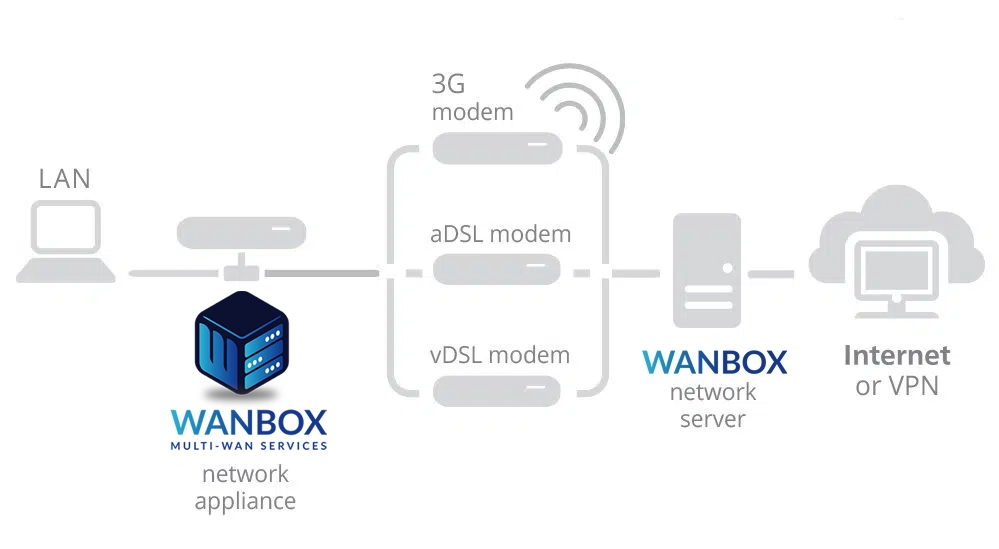
This feature is mainly utilized as a failover mechanism to maintain Internet access when the server infrastructure faces downtime. It is automatically enabled in case the WANBOX network appliance gets disconnected from the WANBOX network server, maintaining Internet access until the server connection is resumed. The session load balancing feature uses a round-robin algorithm to distribute sessions to the available WAN connections. Additionally, it supports sticky connections for compatibility with Internet services that track source IP addresses.
Transparent routing
The WANBOX network appliance offers the ability of transparent routing via the bridged mode functionality.
It enables the transparent operation of the WANBOX network appliance by forwarding the provided public IP addresses to the customer’s internal network. The public IP addresses can be configured on the WAN port of the customer’s edge Router or Firewall appliance. This feature allows the customer to maintain the available network infrastructure without altering the existing network configuration.
State of the art network security
Traffic Authentication at the Node Level
The CPE and the aggregation server authenticate each other using 4096-bit RSA keys and the TLS v1.2 protocol along with the TLS_ECDHE_RSA_WITH_AES_256_CBC_SHA384 strong encryption cypher suite (256-bit AES encryption with SHA-384 message authentication and ephemeral ECDH key exchange signed with an RSA certificate). Keys are generated, managed and signed by a private PKI, avoiding the problems of trusting third-party CAs and presenting a far smaller attack surface by eliminating the complex certificate chain validation risks commonly linked with SSL security. All of the above ensures no attacker can modify or forge bonded traffic between the CPE and aggregation server.
Furthermore, all network traffic between the CPE and the aggregation server can optionally be encrypted using the above algorithm/cypher suite to safeguard the user data transmitted between the WANBOX VLL service endpoints.
Packet-Level Distribution Across Bonded Connections.
By its nature, the technology is highly secure. The packet-level distribution algorithm spreads traffic across multiple Internet connections. Even if an attacker manages to capture one of your individual Internet connections, only a small part of your entire traffic is visible. So, even though this is not a standardized security feature, it clearly provides a strong additional level of security.n server.
Seamless Integration with Existing Network Architecture
Your existing network security design will not be impacted. The technology supports all encrypted VPN traffic, and is also completely transparent to SSL traffic.
Remote Bonding Appliance (CPE) Security
Industry-standard SSL protects the appliance from unauthorized control. The CLI that could be accessed with SSH is equipped with protective functions by using access control lists. All services integrated in the router can be precisely configured in regards to how these services are accessible via which interfaces and IP networks.
Standard IP VPN encryption
The system has the ability to perform SSL IP VPN encryption for hub-and-spoke VPNs using 4096-bit RSA keys with SHA256 certificates, TLS v1.2, and Diffie-Hellman key exchange with elliptic curves.
Our service uses the popular open source Linux distribution CentOS. Many contributors around the world work to enhance the security of this operating system, from reviewing code to ensure security issues are eliminated before release, to implementing fixes within hours of a vulnerability becoming known. You benefit from their experience and abilities
Hardware failover cluster support
The hardware failover cluster functionality eliminates single points of failure and service downtime.
When Internet connectivity is business critical, the customer can utilise dual, redundant WANBOX network appliances. By configuring the devices in a high availability cluster, the backup hardware takes over in case the primary equipment fails. The redundant hardware can also be configured in a passive failover scenario, requiring the user to manually switch the appliances. The latter method is preferred for deployments in extreme conditions for an extended duration of the hardware’s life cycle.
Centralized Service Management and Monitoring
The WANBOX multi-WAN services can be managed remotely via the centralized management platform.
The centralized management platform allows our NOC and our service partners to monitor WANBOX services and remotely manage the available CPEs through a simple-to-use interface. The centralized management platform offers the following functionality:
- Service Monitoring (Reporting and alerting of WANBOX multi-WAN services deployment metrics)
- Remote CPE configuration management